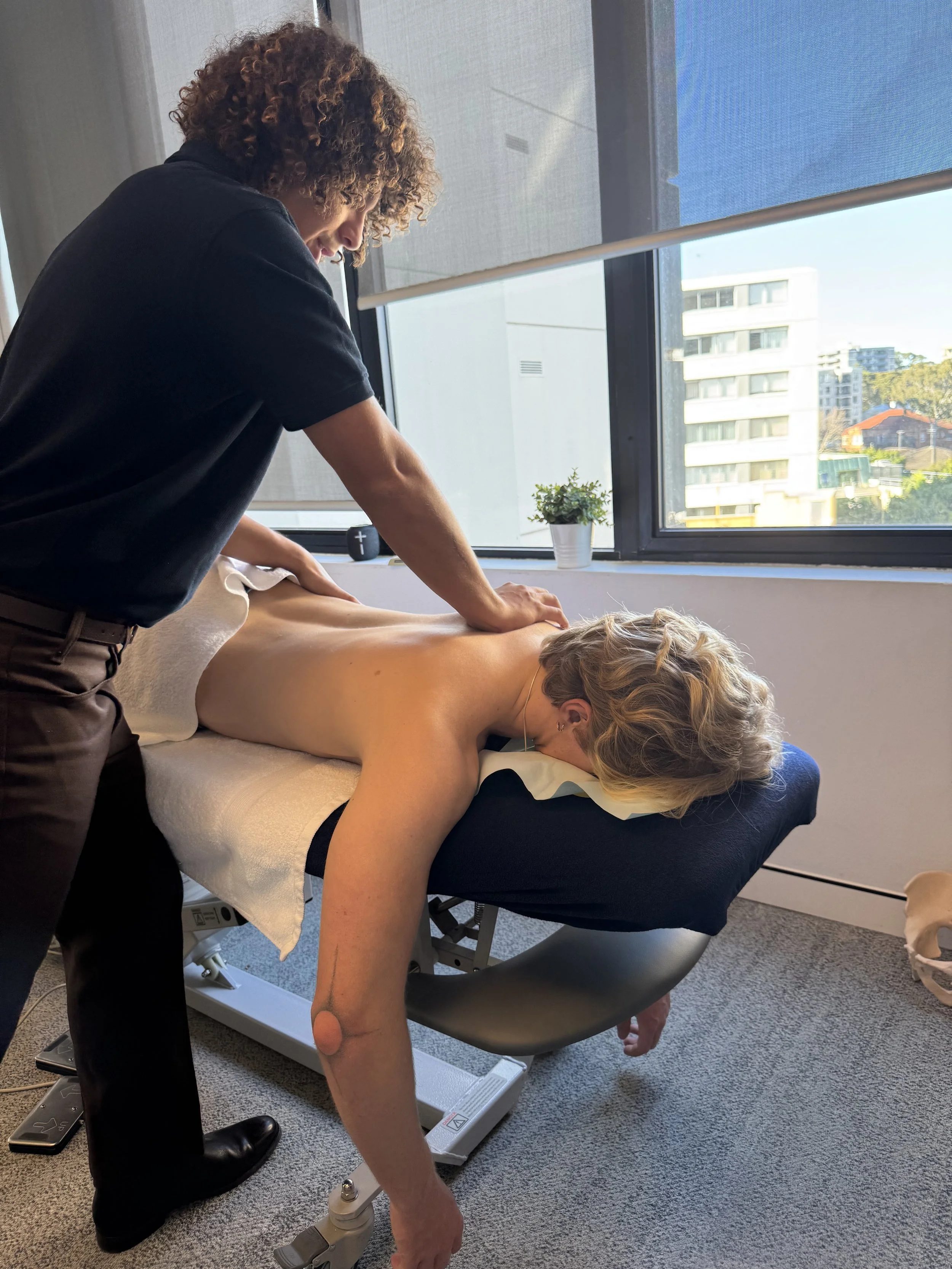
What is Osteopathy?
A Holistic Path to Wellbeing
How Max works — osteopathic care
A treatment plan with Max typically combines hands-on osteopathy as the foundation, with dry needling or shockwave therapy added selectively where clinically indicated. None of these modalities work in isolation — they support an assessment-driven plan adapted to your presentation, your response, and your goals.
What is osteopathy?
Osteopathy is a university-trained, government-registered allied health profession focused on the musculoskeletal system — how your bones, muscles, joints, fascia, and nerves work together, and how problems in that system contribute to pain and restricted movement. Although "osteo" refers to bone, osteopathy is a whole-body musculoskeletal approach.
Osteopaths use a range of hands-on techniques aimed at improving mobility and reducing musculoskeletal pain, alongside exercise and self-management. In Australia, osteopathy is regulated by the Australian Health Practitioner Regulation Agency (AHPRA).
What osteopathic care includes
Beyond hands-on treatment, a course of care with Max can involve:
- Comprehensive musculoskeletal assessment and a working diagnosis
- Manual therapy — soft-tissue work, joint mobilisation and articulation, and manipulation where clinically appropriate
- Dry needling and shockwave therapy (ESWT) where clinically indicated — detailed below
- Individualised exercise prescription and rehabilitation
- Education and self-management strategies for longer-term musculoskeletal health
- Ergonomic, postural, and workplace assessment
- Collaboration with your GP, physiotherapist, or other practitioners when needed
Osteopathy — manual therapy
Osteopathy is a hands-on assessment and treatment of joints, muscles, fascia, and surrounding tissues. Techniques vary from low-velocity articulation and soft-tissue work to, where clinically appropriate and patient-comfortable, higher-velocity adjustment. Manual therapy is adapted to:
- The presentation — a stiff cervical spine is approached differently from an irritable lumbar disc
- Your history and preferences — low-velocity-only is always available by request
- How you respond on the day — treatment intensity is titrated session to session
Manual therapy is designed to work alongside the right exercise and load strategy. Max draws on his physiology training to design that side of the plan.
Dry needling
Dry needling uses fine, single-use sterile needles inserted into specific muscle and connective-tissue points to influence pain, tension, and muscle activation. It overlaps in technique with some forms of medical acupuncture but is framed around musculoskeletal anatomy rather than meridian theory.
Used selectively for:
- Muscle tension associated with neck pain and cervicogenic headache
- Trigger-point patterns in chronic lower-limb tendinopathy presentations
- As an adjunct to manual therapy where clinically indicated
Not used routinely as a standalone treatment, on patients with bleeding disorders or anticoagulant therapy without GP discussion, or on areas with active infection or skin compromise.
Shockwave therapy (ESWT)
Extracorporeal shockwave therapy (ESWT) delivers focused or radial pressure waves to specific tissues. It is used selectively for tendon and soft-tissue presentations where loading alone has not produced sufficient progress.
Evidence suggests ESWT may be beneficial in chronic plantar fasciopathy and lateral elbow tendinopathy, with moderate evidence in calcific shoulder tendinopathy and some patellar tendinopathy presentations. For Achilles tendinopathy the evidence is less consistent as a standalone option — where used, it sits alongside a progressive loading programme rather than replacing it.
A typical course is 3–5 weekly sessions, alongside — never instead of — a progressive-loading programme. Sessions are short (5–10 minutes per area), can feel uncomfortable but are rarely painful, and require no anaesthesia. Individual responses vary — an assessment comes first.
How these modalities combine
Most patients receive manual osteopathy as the backbone, with dry needling added selectively in early sessions for muscle-tension components, and ESWT considered if a chronic tendon presentation has not responded to loading and manual therapy alone over 6–8 weeks.
What osteopathy may help manage
Osteopathy may help manage a range of musculoskeletal presentations, including:
- Low back pain and sciatica — including disc-related and nerve-referred musculoskeletal symptoms
- Neck pain and stiffness — postural, occupational, and cervical musculoskeletal strain
- Cervicogenic headaches — arising from the musculoskeletal structures of the neck and upper back
- Tendon conditions — including plantar fasciopathy, Achilles and patellar tendinopathy
- Sports injuries — assessment and management of acute and overuse musculoskeletal conditions
- Occupational and repetitive-strain discomfort
- Musculoskeletal aspects of arthritis — supportive management of joint pain, stiffness, and mobility
- Pregnancy-related musculoskeletal discomfort — including pelvic girdle pain, lower back and hip pain
- Jaw and TMJ musculoskeletal discomfort
- Age-related musculoskeletal changes and mobility
New to osteopathy? See what to expect at your first visit.
Modalities Max does not offer
- Spinal high-velocity manipulation as a default — used only where clinically indicated and patient-preferred
- Long-term passive treatment plans — every plan includes a self-management component (loading, exercise, ergonomic strategy)
- Procedures requiring medical scope — joint injection, prescribing, surgical decision-making. Max refers to GPs, sports physicians, or surgeons when indicated
Fees vary by clinic — initial $145–$165, follow-up $133–$145 (30–40 min). HICAPS available at all three clinics. See fees & rebates.
Max Bellaiche · AHPRA OST0004003860 · Master of Osteopathic Medicine
Educational content, not medical advice. In an emergency, call 000.